A single price change from one supplier, undetected across 30 locations, can quietly erase hundreds of thousands in annual margin.
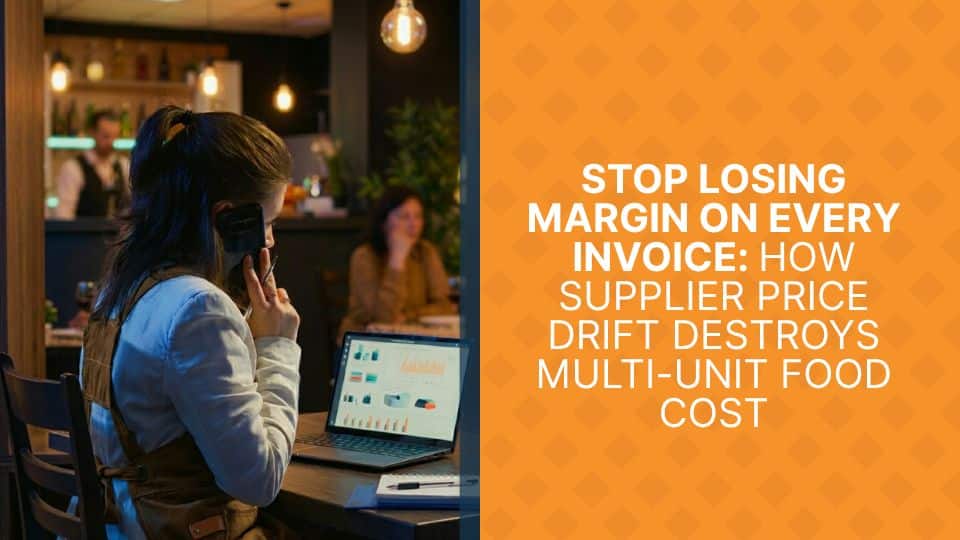
Most operators don’t lose food cost margin all at once. It disappears gradually, invoice by invoice, across dozens of locations, in the gap between the price a recipe was costed at and the price actually paid at delivery. Supplier price drift is one of the most underestimated margin threats in multi-unit restaurant operations, and it rarely shows up until the monthly financial report lands on someone’s desk.
By then, the damage has compounded for weeks.
Why Price Drift Is Harder to Catch Than It Looks
A regional chain with 25 locations processes more than 5,000 invoices every month. Each invoice reflects current supplier pricing, which shifts based on commodity markets, seasonal availability, and contract terms. When ground beef climbs $0.40 per pound, a brand running that item across 20 dishes at 25 locations doesn’t absorb a small fluctuation. It absorbs a structural cost increase that hits every plate, every shift, every week until someone catches it.
That catch rarely happens in real time. Without restaurant purchasing software that compares invoice pricing against approved contract rates automatically, the variance lives in spreadsheets that finance reviews at month-end. Thirty days of drift at scale is not a rounding error. On a 30-location brand doing $2M per unit, a sustained 2% food cost increase from undetected price variance destroys $1.2M in annual EBITDA.
The math is unforgiving. The detection window is the problem.
Three Ways Price Drift Compounds Across Locations
- Off-contract purchasing. When a manager at Location 18 runs out of a key protein and calls a secondary supplier for a fill-in order, that transaction rarely gets flagged. The price is higher. The item is not on the approved vendor list. It does not match the contracted rate. Without automated purchasing controls, it processes as a normal invoice and disappears into the food cost line. Multiply that behavior across a growing portfolio and off-contract spend becomes a systemic drain rather than an isolated incident.
- Unapproved substitutions. Suppliers occasionally substitute items when primary products are unavailable. A lower-grade oil ships in place of the contracted product at the same price. A different cut of protein arrives because the original was out of stock. Without inventory management software that compares received items against purchase orders, substitutions process unchallenged. The recipe runs on a different input than it was costed against, and food cost rises without an obvious cause.
- Contract rate creep. Negotiated supplier rates have expiration dates, annual adjustments, and volume thresholds that trigger pricing changes. When those updates are not tracked systematically, brands often continue paying old rates for weeks, or discover too late that a new rate tier activated at a lower volume than expected. Neither scenario is visible without automated price monitoring across every location’s purchasing activity.
What Centralized Purchasing Controls Actually Fix
The operational model that eliminates price drift is not more manual review. It is architecture that makes non-compliant purchasing structurally difficult to complete. Approved vendor lists enforce which suppliers managers can order from. Contract rate libraries store current pricing and flag invoices that deviate beyond defined thresholds. Automated purchase order matching confirms that what was received matches what was ordered before payment processes.
This is the same principle behind menu testing governance: profitability gates work because they catch problems before they reach the floor, not after they appear in a report. Purchasing controls work for the same reason. When a manager at Location 22 attempts to order from an unapproved vendor, the system flags it at the point of order, not at month-end reconciliation.
The visibility compounds across the portfolio. Operations leaders reviewing cross-location performance analytics can see which locations show consistent food cost variance and trace that variance to specific purchasing behaviors rather than assuming the issue is execution or demand. A location with strong operations but chronically high food cost often has a purchasing problem, not a management problem.
Margin Protection Starts Upstream
Food cost control conversations tend to focus on portioning, waste, and menu pricing. Those matter. But for multi-unit brands, the most consistent margin leak often sits upstream, in purchasing workflows that allow price drift to compound undetected across dozens of locations for weeks at a time.
Closing that gap requires restaurant reporting and analytics that connects purchasing activity to food cost performance in real time, not in next month’s financial report. The brands that protect margin at scale don’t just monitor food cost. They control the conditions that create it.
SynergySuite gives multi-unit operators the tools to close this gap at every layer. The Purchasing module enforces approved vendor lists and automatically compares incoming invoices against contracted rates, flagging deviations before payment processes. Inventory management controls catch unauthorized substitutions at receiving, so what arrives always matches what was ordered. And portfolio-wide reporting connects purchasing activity to food cost performance in real time, surfacing which locations are drifting and exactly why. Together, these capabilities eliminate the 30-day visibility gap where price drift compounds unchecked and turns small variances into significant EBITDA losses.
Ready to stop price drift before it hits your bottom line?