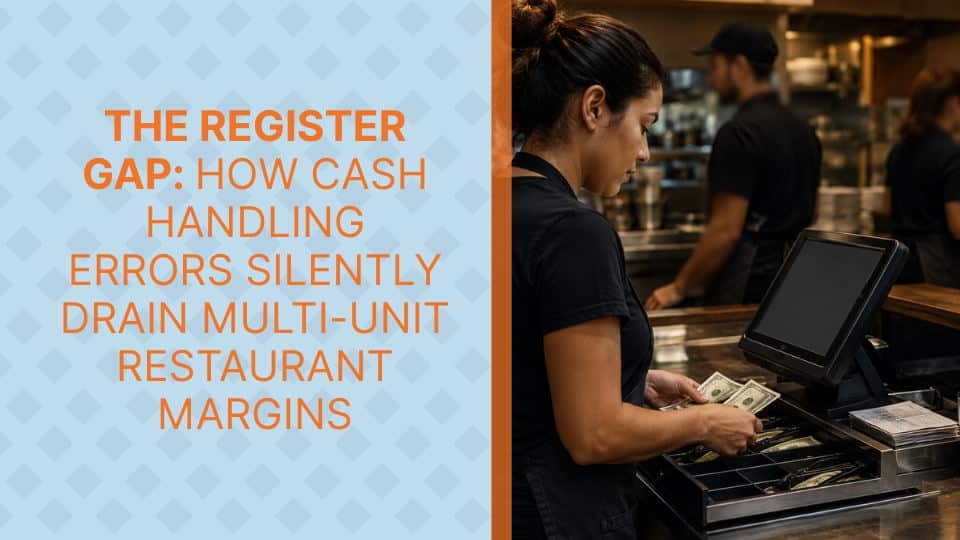
A brand can run tight food cost and optimized labor and still bleed margin at the register. Cash discrepancies are one of the least-tracked cost categories in multi-unit operations.
Food cost gets daily attention. Labor variances surface in real-time dashboards. But cash handling, the daily process of counting, reconciling, and depositing funds across dozens of locations, often gets managed the same way it did ten years ago: a paper count sheet, a manager’s signature, and a deposit that shows up in the bank two days later.
For a single-location operator, that process is manageable. For a brand running 30 or 40 locations, it creates a category of financial exposure that rarely appears cleanly in any report. Cash variances tend to get absorbed into the general noise of daily operations rather than surfaced as a distinct and measurable cost.
Where Cash Losses Actually Happen
Cash discrepancies in restaurants originate from three main sources, each of which operates differently and requires different controls.
Miscounting and handling errors are the most common and least sinister. A cashier counts a drawer short, a deposit is miscounted before it leaves the building, or a float is not reset correctly between shifts. These are errors of process, not intent, and they occur at every location that relies on manual count procedures without digital verification.
Inconsistent reconciliation practices create a second category of exposure. When managers at different locations apply slightly different approaches to counting, recording, and reconciling cash, the reported figures become inconsistent across the portfolio. A location that consistently rounds or estimates instead of counting precisely will show variances that mask the actual over or short position.
Theft and unauthorized adjustments represent the third category. These are less frequent but more damaging per incident. Without a complete audit trail connecting each cash movement to a specific cashier or manager, responsibility is difficult to establish and patterns are difficult to identify before they compound.
Why Manual Cash Handling Breaks at Scale
At 10 locations, a strong controller can review daily cash reports and identify discrepancies within a reasonable window. At 30 locations, that review process becomes a full-time job. At 50 locations, manual oversight is no longer a workable control mechanism.
The structural problem with manual cash management is not that people are careless. It is that paper-based processes produce inconsistent records, create reconciliation gaps that are hard to trace, and surface discrepancies only after the fact. A cash shortage identified three days after a shift ended is not actionable in any meaningful way. The record reflects an average rather than an event.
This delay is why restaurant cash management software matters more as brands scale. Digital cash sheets recorded at shift start and end create a timestamped, signed record for every cash movement. Automated reconciliation compares drawer counts against POS totals at close rather than the next morning. Manager sign-off is captured digitally rather than on paper that may or may not surface in a corporate review.
What Centralized Cash Controls Fix
The most immediate benefit of centralized cash management is accountability at the individual level. When every float count and every safe count is recorded digitally and tied to a specific employee, both errors and patterns become visible in ways they are not when the process lives on paper.
Multi-unit brands can monitor each location’s count frequency and over/short position across the portfolio through restaurant reporting and analytics that aggregates cash performance alongside food cost, labor, and sales data. A location that consistently shows small shortages across multiple cashiers signals a training or process issue. A location that shows a single cashier with repeated variances signals something different. The distinction is only visible when the data is captured systematically and compared across locations.
This cross-location visibility connects naturally to the broader operational discipline that separates high-performing multi-unit brands from those struggling with margin consistency. The same operational gaps that allow labor cost variance to compound undetected also allow cash discrepancies to accumulate without clear attribution. Both problems share the same root: a lack of real-time, location-level accountability.
The Visibility Gap Is the Problem
Cash management rarely makes headlines as a margin lever the way food cost or labor does. That is partly because its impact is harder to quantify and partly because the losses blend into the background of daily operations. A $50 shortage is not an alarm. But $50 across 40 locations, five days a week, is $520,000 annually before any theft is accounted for.
The restaurant operations infrastructure that supports a 40-location brand needs to be able to surface that kind of pattern before it becomes a problem rather than after it has already compounded. Digital cash management, integrated with the rest of the back-of-house platform, makes that possible.
For brands that have tightened food cost, optimized scheduling, and standardized purchasing, the register is often the next recoverable margin category. The tools to close that gap already exist.
See how SynergySuite tracks cash from the register to the bank across every location.