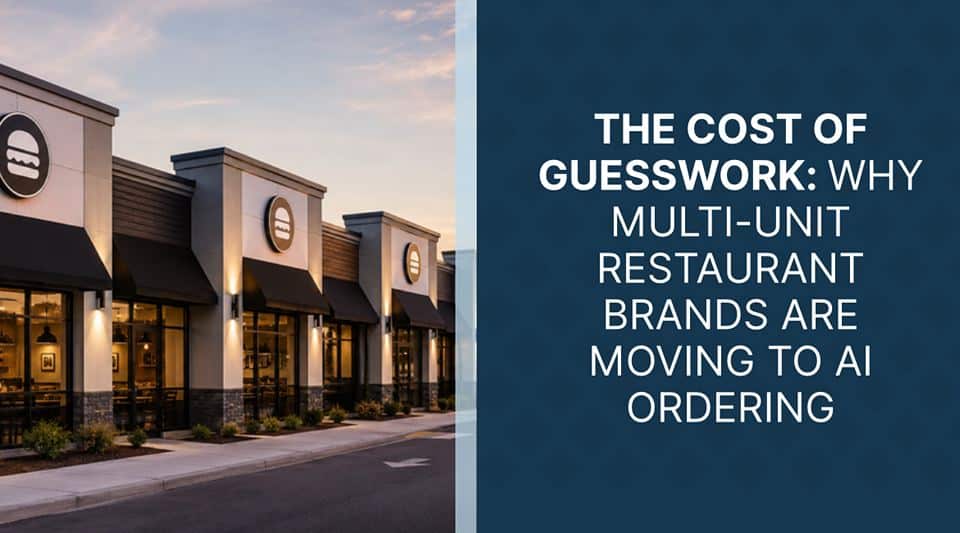
Across a 30-location portfolio, the cumulative margin impact of managers ordering by instinct is far larger than any single order decision suggests.
Every week, general managers make dozens of ordering decisions. Most rely on experience, recent memory, and a rough sense of what last week looked like. On any given day, some of those calls are right. Others are not. Individually, the misses feel manageable. Across 30 locations and 52 weeks, they become one of the most expensive and least visible drains in the portfolio.
Over-ordering means spoilage, excess inventory sitting in walk-ins, and food cost running above target for reasons that are difficult to pinpoint. Under-ordering means 86’d menu items, disappointed guests, and lost sales that never appear in any report because the opportunity disappeared before anyone noticed. Both outcomes are common. Both are preventable.
What Gut-Feel Ordering Actually Costs
The cost of imprecise ordering is not always obvious in financial reports. When a manager orders 20% more chicken than the week’s sales can support, the excess shows up as waste or as inflated theoretical-versus-actual variance. When a manager under-orders a top seller before a weekend rush, the cost appears as nothing at all, because a lost sale leaves no trace in the data.
This asymmetry makes gut-feel ordering particularly difficult to address with standard reporting. Food cost percentages can look acceptable even when waste is high, because waste reduces the denominator alongside sales. The invisible losses, missed sales and habitual over-orders absorbed across multiple line items, do not trigger alerts in a standard inventory management report.
The problem compounds when supplier pricing enters the equation. A manager ordering more than needed during a period of elevated prices, without visibility into current contract rates, amplifies the cost of both the over-order and the price variance simultaneously. As explored in the coverage of supplier price drift, undetected price changes erode food cost across the portfolio. Imprecise ordering accelerates that erosion.
Why the Problem Worsens at Scale
At five locations, a strong operator can calibrate ordering through direct observation and close communication with general managers. At 30 locations, that approach does not hold. Demand patterns diverge by trade area, foot traffic, local events, and day-part mix. What works at Location 4 on a Tuesday may have no relationship to what Location 22 needs on the same day.
Manual forecasting, even when performed by experienced managers, cannot consistently account for all the variables affecting demand at each location simultaneously. Weather changes, nearby events, school calendars, and local business cycles all shift demand in ways that are invisible to someone ordering from memory and last week’s count sheet.
This is the core problem that restaurant AI ordering software solves. Rather than relying on each manager’s individual judgment, the system analyzes historical sales patterns, seasonal trends, local events, weather data, and delivery schedules to generate precise order recommendations for each location. Managers review and approve rather than build from scratch. The margin for error shrinks without requiring any additional management overhead.
The Upstream Role of AI Forecasting
Ordering accuracy depends entirely on forecast accuracy. A precise recommendation built on a flawed demand projection is still a flawed order. This is why forecasting sits upstream of ordering in an effective back-of-house system.
AI forecasting analyzes sales history, guest counts, transaction data, and external demand signals to generate demand projections before the ordering and scheduling cycle begins. That forecast then drives both the ordering recommendation and the labor plan, creating a consistent operational baseline rather than two separate estimates that may contradict each other.
For multi-unit brands, the compounding effect of improved forecast accuracy is significant. A consistent improvement in order precision across 30 locations does not produce a proportional improvement in food cost. It produces a structural change in how reliably every manager can execute to target, every week. Waste decreases. Stockouts decrease. Labor plans align more accurately to anticipated volume.
Closing the Loop with Purchasing
Order accuracy improvements are most durable when they connect directly to purchasing controls. A well-calibrated order placed with an unapproved vendor at an off-contract price recovers less margin than it should. Restaurant purchasing software that enforces approved vendor lists and validates invoice pricing against contracted rates ensures that the precision introduced at the ordering stage carries through to the invoice.
The full loop, from AI-generated order recommendation to approved vendor submission to invoice verification, is where the cumulative margin improvement becomes most visible. None of those stages operates well in isolation. When they connect through a unified platform, the result is a system where guesswork has been removed at every step.
From Reactive to Precise
Multi-unit restaurant brands that still rely on manager intuition for ordering are not operating with a people problem. They are operating with an information problem. The data needed to make precise ordering decisions exists. The question is whether the platform in place processes that data into actionable recommendations before each order is placed, or leaves managers to interpret it on their own.
The cost of guesswork is not a rounding error. At scale, it is one of the most consistently recoverable margin opportunities in the portfolio.
See how SynergySuite AI Ordering eliminates guesswork across your entire portfolio.