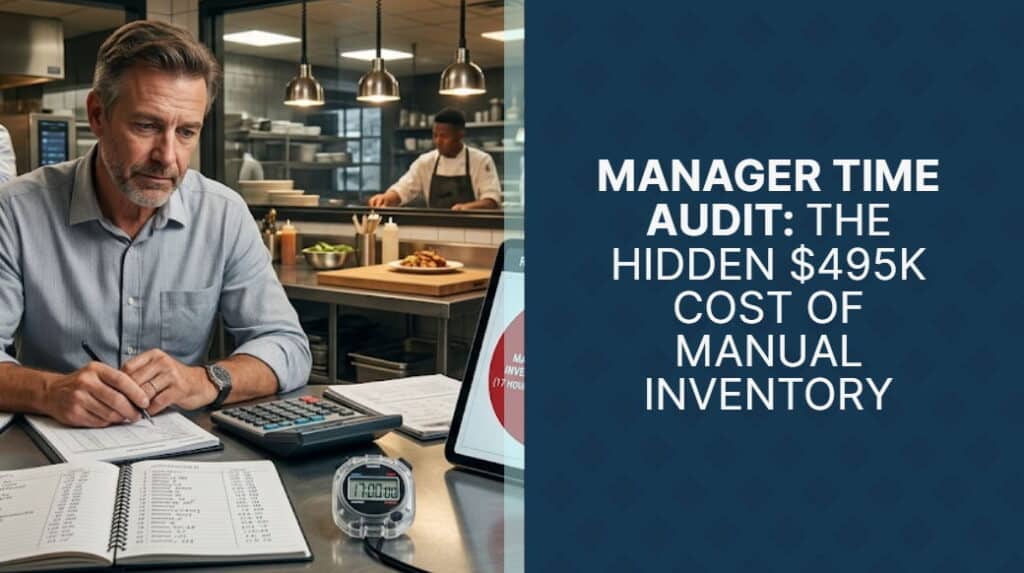
For Operations Leaders and Regional Directors, 17 Weekly Hours on Clipboards Means 17 Hours Not Spent Leading Teams
Restaurant managers work minimum 50-60 hour weeks. Industry research shows they spend 15-20 of those hours on manual inventory tasks: counting stock with clipboards, reconciling invoices against delivery receipts, entering data into spreadsheets, and generating cost reports. That’s nearly one-third of their time devoted to administrative work instead of coaching teams, improving service, or developing talent. For a 20-location restaurant group, this pattern creates a hidden opportunity cost. When general managers function as data entry clerks rather than operational leaders, the entire organization operates below its potential. Restaurant manager productivity software doesn’t just save time. It redirects leadership capacity toward activities that actually improve performance.
When Your Best Leaders Become Clipboard Counters
Walk into any restaurant early Tuesday morning and you’ll likely find the GM in the walk-in cooler. Clipboard in hand. Pen behind ear. Counting cases of lettuce, cans of tomatoes, bags of flour. Line by line through a template listing 200+ inventory items.
This weekly ritual consumes 4-6 hours depending on restaurant size and inventory complexity. The GM counts everything, writes quantities on the clipboard, returns to the office, and transfers those handwritten numbers into a spreadsheet. Then they calculate current inventory value by multiplying quantities by unit costs pulled from recent invoices. The spreadsheet formulas produce a total inventory valuation that gets emailed to corporate by Wednesday afternoon.
But Tuesday’s counting session is just the beginning. Thursday brings invoice reconciliation. Suppliers delivered orders Monday, Tuesday, and Wednesday. Each delivery included a paper invoice that got filed in a folder. Now the GM matches those invoices against what actually arrived, verifies pricing, checks for errors, and enters everything into the accounting system. Another 3-4 hours disappears into administrative processing.
Friday involves order planning for next week. The GM reviews current inventory levels from Tuesday’s count, checks which items are running low, estimates next week’s needs based on experience and gut feel, and places orders with multiple suppliers. Each supplier requires a separate order process: phone call, email, or web portal. Add another 2-3 hours.
By Saturday, the GM has dedicated 10-12 hours this week to inventory management. Sunday through Monday bring additional time reconciling variances, investigating discrepancies, and explaining to regional management why food cost ran higher than target. Weekly total: 15-20 hours of pure inventory administration.
According to restaurant operations research from 2025, this time allocation is industry standard. The challenge isn’t that managers are lazy or inefficient. The challenge is that manual systems inherently require extensive time investment, and that time comes directly from leadership activities that actually drive performance.
The Leadership Activities That Don’t Happen
While the GM spends Tuesday morning counting inventory, several leadership opportunities pass uncaptured. The breakfast shift runs with yesterday’s training issues unaddressed. The prep cook who struggled with portion control Monday doesn’t receive coaching. The new server scheduled for first solo shift gets minimal supervision. The kitchen team operates without feedback on last night’s service challenges.
These aren’t dramatic failures. The restaurant functions. Food gets cooked. Guests get served. But continuous improvement stalls. Team development slows. Performance gaps persist because the person responsible for addressing them is in the walk-in counting lettuce cases.
Consider what effective leadership actually requires. A GM needs to observe service during peak periods to identify operational bottlenecks. They need to conduct one-on-one coaching sessions with struggling employees. They need to review sales data to spot menu performance trends. They need to walk the floor during service to reinforce standards and celebrate wins. They need to recruit new talent as turnover inevitably occurs. They need to build relationships with guests to gather direct feedback.
None of these activities happen while counting inventory. And because inventory counting operates on a fixed schedule, it consistently consumes the same hours weekly regardless of other demands. Tuesday morning isn’t flexible. The count must happen before orders go out. So leadership activities get deferred, postponed, or skipped entirely.
According to data from restaurant labor management research, managers working 60-hour weeks report that administrative tasks consume 30-35% of their time. That’s 18-21 hours weekly spent on paperwork, data entry, and manual processes. For a high-performing leader, those hours represent massive opportunity cost.
How Automation Redirects Time Toward Leadership
Restaurant manager productivity software changes the time equation fundamentally. Instead of clipboard counting that requires 4-6 hours, mobile inventory apps complete counts in 90 minutes. The GM walks through storage areas with a tablet, scanning barcodes or typing quantities directly into the system. The software automatically calculates values using current pricing pulled from integrated supplier data. No clipboard. No transcription errors. No spreadsheet formulas.
Invoice reconciliation transforms from 3-4 hours to 30 minutes. The system receives invoices electronically or via photo capture. Automated cost tracking matches delivered items against purchase orders, flags pricing discrepancies, and posts everything to accounting automatically. The GM reviews exceptions rather than processing every line item manually.
Order planning shifts from gut-feel estimation to data-driven suggestions. The system tracks usage patterns, forecasts demand based on historical sales, and generates recommended order quantities. The GM reviews the suggestions, adjusts for known events or special needs, and submits orders electronically to all suppliers simultaneously. What previously consumed 2-3 hours now takes 45 minutes.
Weekly inventory administration drops from 15-20 hours to 4-6 hours. That creates 10-15 hours of recovered time that can redirect toward leadership activities. According to Supy’s 2025 inventory management guide, restaurants using digital systems can save 40+ staff hours monthly by automating manual processes. For a GM making $65,000 annually, that time recovery has direct financial value, but the operational value exceeds the pure labor cost.
Those recovered hours enable the GM to spend Tuesday morning on the floor during breakfast service, observing operations and providing real-time coaching. They enable Wednesday afternoon one-on-ones with team members who need development. They enable Thursday evening menu analysis reviewing which items perform well and which need attention. They enable Friday recruitment calls interviewing candidates for open positions.
The restaurant doesn’t just save administrative hours. It gains leadership hours. The GM transforms from clipboard counter to actual manager. Team performance improves because leaders have time to lead.
Portfolio Impact: 20 Locations With 20 Distracted Managers
The time problem multiplies across multi-unit portfolios. A 20-location restaurant group employs 20 general managers. If each spends 17 hours weekly on manual inventory, that’s 340 hours consumed weekly across the portfolio. That’s 1,360 hours monthly. That’s 16,320 hours annually.
Those hours represent pure opportunity cost. Every hour spent counting inventory is an hour not spent improving the operation. When all 20 locations operate with distracted leadership simultaneously, the portfolio-wide performance gap becomes structural.
Regional directors visit locations and observe the same pattern everywhere. Managers are busy. They work hard. But they’re buried in administrative tasks rather than focused on operational excellence. Food cost runs high because portion control issues don’t get addressed quickly. Labor efficiency suffers because scheduling remains reactive rather than optimized. Guest satisfaction fluctuates because service standards aren’t consistently reinforced.
According to research on GM time optimization, multi-unit operations benefit most from centralized systems that standardize processes across all locations. When inventory management becomes automated, all 20 managers gain time recovery simultaneously. That creates portfolio-wide leadership capacity that didn’t exist under manual systems.
The operations team can now implement training programs knowing managers have time to execute them. They can roll out new menu items confident that managers will properly train kitchen teams. They can set performance standards expecting managers will actually observe and enforce them. The entire organization operates more effectively because leadership capacity is no longer consumed by clipboard counting.
The Verdict: Manual Inventory Steals Leadership Hours That Drive Performance
Restaurant managers lead teams, develop talent, improve operations, and drive guest satisfaction. These activities require time, attention, and presence. Manual inventory systems consume 15-20 hours weekly on administrative tasks that generate zero value beyond basic record-keeping. For multi-unit operations, this time allocation creates systematic underperformance across portfolios because leadership happens only after inventory gets counted.
Labor efficiency improves when automation handles administrative work, freeing managers to focus on the activities that actually matter. The financial value isn’t just saved labor hours. It’s recovered leadership capacity. When 20 general managers each gain 10-15 hours weekly for coaching, training, and operational improvement, the entire portfolio performs better.
The technical requirement is inventory automation ROI that reduces counting time by 60-75%, eliminates manual data entry, and provides real-time visibility without spreadsheet management. When the system handles the administrative burden, managers gain time to lead.
For operations leaders and regional directors, the question isn’t whether to automate inventory. It’s whether you can afford to keep your best managers functioning as clipboard counters instead of team leaders.
Audit Your Current Manager Time Allocation. Identify where leadership hours disappear into administrative tasks.